The UAE’s art market is on the up
From the June 2025 issue of Apollo. Preview and subscribe here.
The international art market can be fickle. Its first flurry of interest in the
United Arab Emirates was in the early 2000s, when the art world was rapidly becoming more global. Suddenly
contemporary artists from the Middle East – as well as Brazil, Russia, India and China – were all the
rage.
Christie’s held its first modern and contemporary art auction in Dubai in 2006,
making a respectable $8.5m for Arab, Iranian and Indian artists. A year later, the first edition of the Art
Dubai fair opened, founded by a pair of entrepreneurial Brits. The UAE’s Abu Dhabi-based government started to
negotiate deals with the Louvre and the Guggenheim to build offshoots of the world-famous museums.
The financial crash of 2008 was a severe setback. But nearly two decades on, as its
economy booms, the UAE is back in the spotlight. Sotheby’s, which opened an office in Dubai in 2017, showed off
a $100m collection of coloured diamonds in Abu Dhabi in April before their sale in Geneva. This followed the
revelation last year that an Abu Dhabi sovereign wealth fund, ADQ, had paid $1bn for a 25–30 per cent stake in
the auction house.
Edward Gibbs, chairman of Sotheby’s Middle East and India, says that the region is
now ‘extremely important in terms of growing revenue and deepening the relationship with our new co-owners’. He
has worked in the Gulf since the early 1990s and believes that ‘there is huge potential in the Middle East.
There was a pause after the financial crash, but the UAE is surging back’. He says that the number of bidders
from the region has grown by 70 per cent over the past five years.
Christie’s is also eyeing the Gulf again. It has had an office in Dubai since 2005
and is increasing its staffing in the city. ‘The UAE, and indeed the Gulf as a whole, is a market of great
potential. We are very excited by it,’ says Anthea Peers, president of Christie’s Europe, Middle East and
Africa. She says that sales of modern Middle Eastern art, a favourite of local collectors, trebled in value
between 2020 and 2024.
Months of speculation that Art Basel would launch a fair in the Gulf – possibly in
Abu Dhabi, with which is it believed to have had lengthy discussions – came to an end last month with the
announcement that the fair had finally clinched a deal with neighbouring Qatar,
about an hour’s flying time from Dubai. Art Basel Qatar will launch in February
2026, a move that the Financial Times declared ‘cements the Middle East
as the next frontier in the global art market’.
The fair will no doubt give a boost to Qatar’s burgeoning art scene, which has opened five major museums and several
arts spaces since 2008. But for now, almost all commercial galleries in the region are based in Dubai. April’s
edition of Art Dubai was judged by many to the best edition for many years. Maliha Tabari, a pioneer of the Emirati
art scene who founded Tabari Artspace in 2003, says: ‘In many ways we are still on a learning curve. But this year
Art Dubai brought in really interesting international curators and museums, and they found what we are doing
fascinating.’
The organisers of the fair say that curators came from overseas museums including the Tate, the Baltimore Museum of
Art and the Whitney Museum of American Art. Major collectors, including Usha Mittal and Sultan Sooud Al Qassimi, a
member of Sharjah’s royal family, were spotted. International galleries are once again moving in: Continua
opened in Dubai in 2021 and Perrotin in January, and locals say that others are looking too.

The Art Dubai fair, in the grounds of the Madinat Jumeirah Hotel. Photo: Spark Media
The shift in international perception has come as the UAE has transformed itself
faster than expected. The seven emirates that make up the union – Abu Dhabi, Dubai, Sharjah, Ras Al Khaimah,
Fujairah, Umm Al Quwain and Ajman – were once a series of small pearl fisheries bordered by Saudi Arabia, Oman
and the Persian Gulf. From the 19th century to the 1960s they were a British protectorate. Oil was first
discovered in Umm Shaif near Das Island, Abu Dhabi, in 1958; by 1972, all seven were independent and had formed
the UAE, with Abu Dhabi as its capital.
Oil has made the emirates wealthy. The UAE pumps nearly 5m barrels a day and,
according to OPEC, has bigger crude oil reserves than Russia. Oil earns the federation roughly $100bn a year, or
$100,000 per Emirati citizen. There are an estimated 10m people in the UAE, of which only 1m are citizens – full
citizenship is open to foreigners only in rare circumstances.
But the current boom owes more to the government’s determination to create a robust
post-oil economy; oil now accounts for less than a third of its GDP. The government has used its oil wealth to
invest strategically in important industries at home and abroad and, led by Dubai, has created low-regulation,
low-tax economic zones.
The UAE signed normalised diplomatic relations with Israel in 2020 and decided not
to
implement sanctions against Russia. Israelis and Russians have moved to
the region, joining Americans, Europeans, Indians and Africans, as well as Lebanese, Palestinians and
Jordanians. They are attracted by high-paid, low-taxed jobs and the ease of setting up businesses. The
Economist, in a report
coinciding with the COP 28 climate-change conference hosted in Dubai in 2023, wrote: ‘The messier the world gets
the more the UAE seems to thrive.’
The strategy appears to be working. The non-oil parts of the economy have been
growing at six per cent a year since 2022, the Economist
reports. Henley & Partners, an international wealth management
firm, placed the UAE at the top of its list of ‘millionaire inflows’, with an estimated 6,700 moving there in
2024. ‘Post-Covid, Dubai has become a magnet for talent and money, and that means more people buying homes,
living here and buying works of art,’ says Elie Khouri, a Lebanese-French entrepreneur and art collector.
Meanwhile, the government has been investing in big-ticket cultural projects,
especially in Abu Dhabi. In April, the UAE hosted its annual Culture Summit, a glittering event by arts
conference standards. Speakers included the former prime ministers of New Zealand, Slovakia and Mauritius, 20
international culture and education ministers and senior executives from Google, as well as architects, artists
and museum directors.
The conference took place on Saadiyat Island, a new culture and tourism district created with an initial budget of
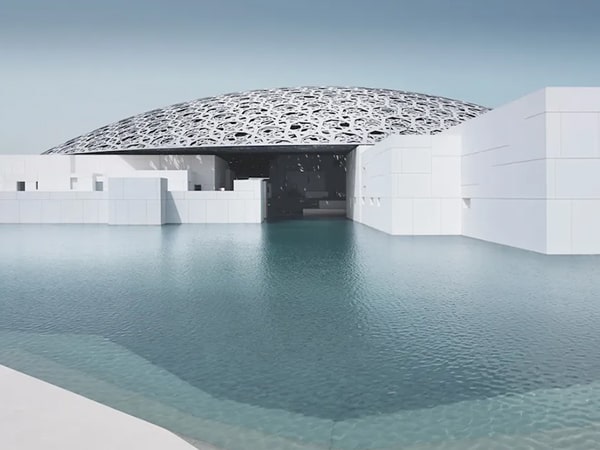
$27bn. The Louvre Abu Dhabi opened there in 2017, the Abrahamic Family House interfaith centre in 2023 and the new
teamLab Phenomena in April. They will be soon joined by the Foster + Partners-designed Zayed National Museum, the
Mecanoo-designed Natural History Museum and Frank Gehry’s Guggenheim Abu Dhabi. The total cost of all of these is
undisclosed but construction alone must have cost several billion dollars.
This huge investment in culture is encouraging new galleries to open in Dubai and
even in more restrained Abu Dhabi. Maryam Al Falasi set up Iris Projects last November in Mina Zayed – a former
industrial area near Abu Dhabi’s port that also houses the independent, non-profit arts space 421. ‘Abu Dhabi is
the perfect ecosystem, you have the artists, you have the collectors and the museums. The only thing that was
missing was a contemporary gallery,’ Al Falasi says, explaining why she chose the capital.

Installation view of Manifesto: The Language and the City (2021) by Abdullah Al
Othman at Art Dubai, 2025. Courtesy the artist and Iris Projects
NIKA Project Space opened in Dubai in 2023 to focus on artists from ‘marginalised
countries such as Mongolia and Kazakhstan’, according to its Russian founder, former lawyer Veronika Berezina.
‘It’s exciting to be a part of this evolving art scene and to be able to bring something meaningful to it,’ she
says.
Efie Gallery, founded in 2021 by London-, Ghana- and Dubai-based Valentina Mintah
and
her two sons, Kwame and Kobi, is gaining a reputation for exciting shows. It focuses on artists of African
origin and earlier this year opened a large new space in Alserkal Avenue, with a music room and cafe
attached.
Kwame Mintah says that the mindset in the UAE is part of the appeal. ‘The ease of
doing business here means you don’t have time to doubt yourself – it is so fast to get something off the ground.
And the city is very diverse, it’s very appealing to be somewhere where almost everyone else is an immigrant
too.’
Attitudes to art are less constrained, he says. ‘In the West, everything to do with
African art is looked at through the lens of colonisation. That is an important topic, but we wanted to get to
the point where African art has the same level of freedom as everything else, where anything can be
“African”.’
‘It’s almost overwhelming how fast things have developed,’ says Sunny Rahbar, who
founded The Third Line gallery in 2005. ‘When we opened, there was almost nothing going on here – you couldn’t
even find picture framers. And now we are in another super-growth phase: there are new, good-quality galleries,
there are new collectors, even young people in the tech sector, the “crypto bros”, are buying art.’
But with 20 years’ experience, Rahbar knows that things can easily change. ‘There’s
been a series of booms and busts here. Maybe we’ve arrived at a place where we’re going to stabilise, but you
never know,’ she says.
There are other reasons that anyone looking for a quick return in the UAE should be cautious. The scene is still
small – there are maybe as few as 30 galleries, insiders say – and prices are relatively low. At Art Dubai, Zawyeh
Gallery, based in Dubai and Ramallah, sold works by Nabil Anani priced between $100,000 and $650,000, but most sales
were in the $30,000 range.
The focus of most local collectors is on the artists of the Middle East and not
beyond. ‘People are very patriotic and support the art of their region,’ says Katia Nounou Boueiz, deputy
chairman of Sotheby’s Middle East. Many more prefer to buy luxury goods – watches, jewellery, cars and high-end
property, which has boomed in recent years.

Alserkal Avenue, in the former industrial zone of Al Quoz, Dubai. Courtesy Alserkal Arts
Foundation
Grassroots aspects of the art scene remain under-developed – opportunities for
artists to study and work in the UAE in the early part of their careers are limited. ‘There’s a great sense of
community and appreciation and patronage,’ says Faisal Al Hassan, director of 421. But affordable studio space
in such expensive cities is hard to find. ‘There’s a big gap [for artists] before they have representation by
international galleries or show in major institutions. And there aren’t yet enough curators who are trained here
and can talk about our region,’ he says.
For all its many attractions, life in the UAE is not for everyone. The emirates have
set out ambitious targets to reach net zero by 2050 but they have a long way to go. The climate means that per
capita carbon emissions are some of the highest in the world, according to the Global Carbon Project. It is
socially one of the most liberal states in the region but
politically is a de facto autocracy, and media comment on the government, the royal families and religion is
tightly controlled. Many accept this for the trade-offs – prosperity and security – but it may appeal less to
more politically minded artists, curators or art critics.
Nevertheless, for many the UAE remains one of the most exciting emerging regions in
the art world. Mariët Westermann, director of the Guggenheim group of museums, was in Abu Dhabi to speak at the
Culture Summit, after several years as vice-chancellor of NYU Abu Dhabi. ‘It is utterly inspiring to work in a
country with long-term vision and the willingness to put resources into its cultural endeavours,’ she says. ‘If
people spend time here, they will get a different picture: this is a flourishing, cohesive and diverse
society.’
The summit coincided with the closing days of the new Public Art Biennial Abu Dhabi.
It presented work by nearly 60 artists and collectives, including 40 new commissions, in public spaces around
the city. Some of the overseas artists were in town and contrasted the funding and enthusiasm of the UAE
government with shrinking budgets and political interest at home. ‘Artists want the chance to make the best work
they can,’ one said. ‘This region feels like the future.’
Apollo